Train your leaders
Develop a practical understanding of AI using examples from the work your business does.
Commercial · AI for midmarket operations
The proposals still need writing. Customers still need answers. Your best people keep getting pulled back into work someone has already done.
We train leaders to identify where AI can address the problems that matter to your business. Then we provide the leadership and technical resources to implement the applications you choose.
The work on your desk
Keep your people
on the judgment.
Illustrative work examples. Your process, data, and review requirements determine the design.
Training. Priorities. Implementation.
Develop a practical understanding of AI using examples from the work your business does.
Assess the use cases against business value, data readiness, and the effort of implementation.
Bring in AI leadership, data and development expertise, and support for the people using the result.
Illustrative testimonial
The training helped us see where AI fit our business. Then we had the people to tackle the work we had identified.
The constraint comes first
Quotes, proposals, onboarding documents, support answers. Start with repeatable work your skilled people spend too much time assembling.
Map how work actually moves. Find the handoffs, duplicated effort, and decisions worth improving before buying another tool.
Your team needs more than access. Give people useful examples, clear boundaries, and practice with the work they recognize.
In production
Three kinds of system, each running in production. Each started as a bottleneck somebody described out loud. Your version starts with your material.
Your expertise
Your method lives in binders, old decks, and senior people's heads. Turn the material into an advisor that uses your method and cites your sources.
The approach: retrieval over your documents, with citations people can check.
Working memory
Build durable memory around the context a person has agreed to share. Preferences, decision patterns, and team context can inform later sessions. Update what matters as circumstances change.
The approach: durable memory and pattern extraction, designed for the engagement.
Volume work
Spreadsheet exports, form responses, and intake data go in. A structured narrative and branded report come out for review. Put skilled attention on the decisions the report supports.
The approach: structured intake, narrative generation, and branded output.
These are custom systems built for specific engagements. Their data, memory, output, and review requirements shape each implementation.
The wider map
Sixteen more applications for midmarket teams. Each gets assessed against your data, risk, and return before it touches your budget.
Find the handbook answer and the source your team can check.
Prepare for a hard conversation using your policies and context.
Help new colleagues find how work happens here.
Find policies, prior decisions, and deliverables in your material.
Classify, summarize, and route requests for the responsible person.
Draft a readable explanation of the close your team already ran.
Surface terms, renewals, and overlapping tools for review.
Prepare answers using your product and policy material.
Draft notices and difficult replies. Keep a person responsible for sending.
Classify requests and identify relevant existing templates for review.
Surface clauses, dates, and obligations for a person to verify.
Find positioning, objection answers, and proof in your material.
Extract proposed decisions and owners from the notes you take.
Offer selected agents on your domain with configured access.
Define how staff can use the tools and information responsibly.
Help teams use, question, and improve the tools in real work.
The right answer may be a better process, a simpler tool, or a decision to stop. The evidence determines what gets built.
AI Workspaces
Your brand. Your domain. Selected agents for your team, customers, and partners. Bring them together in an AI Workspace with internal and external Studios.
Deploy agents through Studios, pages, direct links, website embeds, email, supported messaging, meetings, API, and MCP.
Channels depend on the selected plan, agent type, connections, and configuration. Our services provide the assessment, build, training, and support around your platform.
See Workspace examples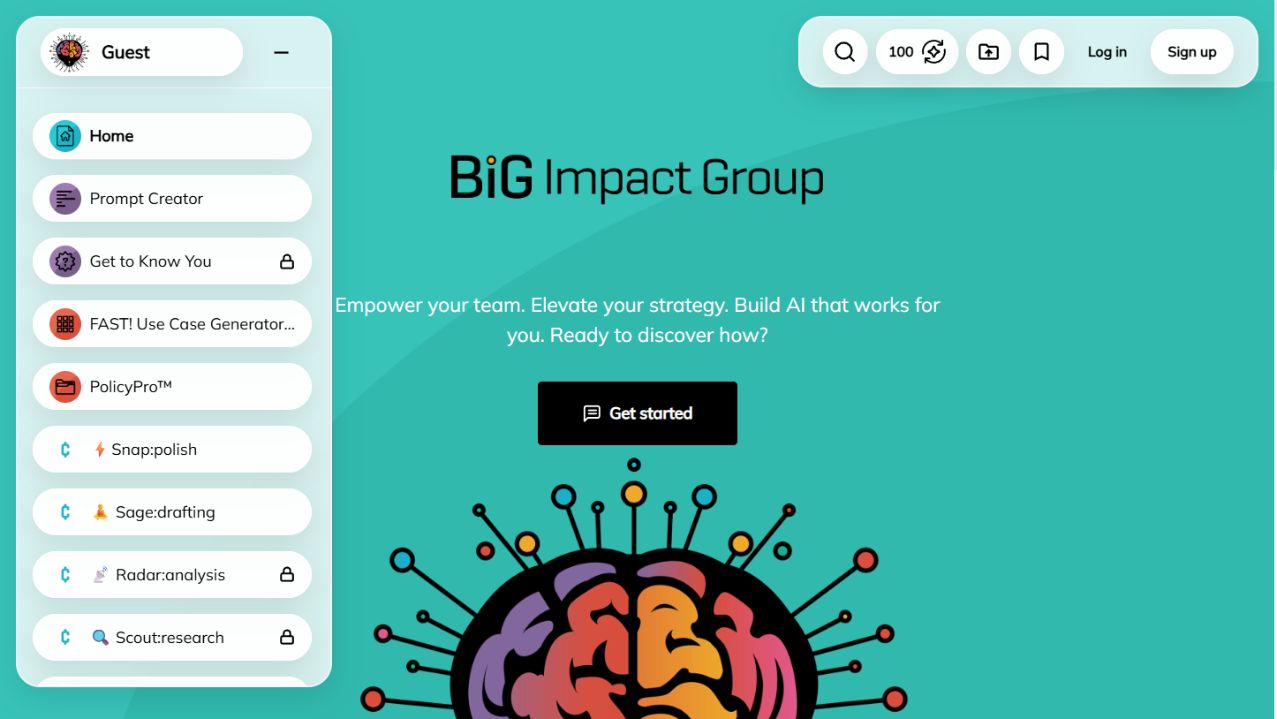
Bring the work that scales badly
Bring one bottleneck and a picture of how the work moves today. Find the first useful step with BiG Impact Group.
Book a 30-minute discovery callA page for the next internal conversation
We train leaders to identify where AI can address the problems that matter to your business. Then we provide the leadership and technical resources to implement the applications you choose.
Last updated